


Mary, Queen of the Holy Rosary Catholic Church – Parish History
The title of Our Lady of Victories dates back to a historic battle between Christian and Moslem forces at Lepanto in 1521. The Moslems had invaded much of Spain and were threatening to overrun most of Europe and de-Christianize Europe. The threat was real and it all came together at a sea battle at Lepanto. Realizing the importance of this moment the Pope, Pius V, called upon all Christians to pray the Rosary for the success of this battle. The Christian forces prevailed, Europe was saved for the Christian Faith and the Moslems were pushed back to Africa. In honor of the victory, the Pope declared Mary the Lady of Victory and declared her feast day to be held on October 7, the Feast of 'Mary, Queen of the Holy Rosary'. Thus, the origin of the name for our Parish.
Much of this history was compiled in 1960 by George C. Staed, a founding parishioner. Many others have gratefully contributed.
We are in need of names and dates for several significant donors' items that have been contributed.
Overview:
Mary, Queen of the Holy Rosary Parish initially grew out of St. Paul’s Parish in downtown Lexington (a part of the Diocese of Covington). Bishop Ackerman established the new parish because of the growing Catholic population in Lexington. Initial expectations were that it would reach 500 families. Masses were held at the then-new Lexington Catholic High School on Clays Mill Road. In 1962, Mass was moved to the new building near the corner of Clays Mill Road and Hill N’ Dale Drive. Several expansions were made on the building, when in 1995; a new church building was begun on the corner of the lot (seating 800). In 2005, the old building was demolished, being replaced by the new Education Life Center (accommodating 600 students). On October 1, 1995, our current church was dedicated. As with many parishes, we experienced some stressful times in our history. Policies, such as VIRTUS, were put in place to help insure healing and that these would not re-occur. In 2008, a Sunday Mass, in Spanish, was added, adding 800 Hispanic families to the parish. In 2014, two thousand families were registered in the Parish. In 2020 a major renovation of the church took place which included new pews, sound system, and flooring and paint throughout the building
1962: The original plans called for the construction of a church, a school for grades 1-8, a rectory, and a convent on the eleven acres of land. The first building built was a dual purpose structure, built in the shape of a modified cross. The classrooms formed the arms of the cross. A kitchen, and utility room were at the end of the large room which would serve as a parish hall (“The Church”) and lunchroom. The church area was in the center. An initial clear window stood at the north end of the room.
The other end was comprised of a raised dual purpose Altar, with a chapel for daily Mass behind it. For daily Mass, an accordion partition separated the chapel from the multi-purpose room/church. A classroom to the side of the church, with a window facing the worship area, was used on Sundays for a "cry-room."
People came into Church in an unusual fashion, facing the congregation instead of the altar. Parish events took place in this space. A convent to house the Sisters of Notre Dame (who were to teach in the school) was built above one section of the classrooms. There was a third cluster with a school office extending off the main entrance hall. This building was completed and dedicated April 15, 1962. It had a distinguishing feature in that all the classrooms in the building opened to the outside.
The Altar table was raised above the chapel and Multi-Purpose room floor and consisted of a single slab of marble, provided by Martina Brothers of Lexington. As Vatican II had directed that the priest face the people during Mass. It was difficult to see the priest behind the Tabernacle, so a hole was cut in the Altar top and a new Tabernacle was designed and recessed there.
The heating and hot water system were located above the Chapel. This fed all the rooms and convent with heat and all the restrooms with hot water. Each of three clusters of classrooms had it's own restroom facilities.
1964:
A 'Rosary Prayer Garden' was implemented near the classrooms of the school office wing.
1967: As the years passed, a new rectory/office was built at 601 Hill N’ Dale with space to house three priests. Additional sections were added to the school to meet the growing needs of the parish. Additions to the building included a fourth cluster with a library and three classrooms, and a lunchroom. Prior to this lunch was eaten in the multi-purpose room.
The young parish experienced the growth of the Lexington area. Again and again there was the desire expressed for building a church in which to give fitting worship to God.
1970: In the 1970’s, hope for a new church building again surfaced. As the hope was expressed, also there was the ever present concern as to financing the project. And so, the idea of a new church was put on the back burner. In place of a new church, the parishioners decided to renovate the interior of the parish hall and make it a fitting place of worship. The hall then would then take on more the atmosphere of a worship area.
The Multi-Purpose Room was renovated into a permanent church. T he floor was carpeted and pews were installed replacing folding chairs. The Altar was moved to the to the opposite end of the room. In order to create space for the Altar, a partition was built 10 feet from the north end, with a raised platform. A newly installed stained glass window was designed by Van Rohen, owner of Finestra Stained Glass in Louisville, Ky. This was mounted outside the current clear window over the Altar. The artist stated the design represents “ The Tree of Life”. The walls at either side of the window curved out to resemble an open book. People now entered the church facing the Altar.
A new adjoining structure was added. It consisted of a new gymnasium with a P.E. Office, restrooms, kitchen and cafeteria. T he former scout room and kitchen were converted into two classrooms for kindergarten. The former lunchroom was converted into two more classrooms.
1980: Father John Mueller, a priest from Covington, was appointed as Pastor for Mary, Queen of the Holy Rosary.
Parishioners Dom and Libby Dalesio generously donated a new large Crucifix to hang over the Altar, a new Tabernacle, processional cross, and small ornate Stations of the Cross.
In 1980, another parish ( St. Elizabeth Ann Seton) was formed, taking 200 families from our parish.
1983: The growth and expansion of the parish continued as the population of this section of town developed. Members of the parish became concerned over the crowded conditions at worship, in the school and other out-of-school activities. There was a lot of discussion regarding the establishment of another parish and/or the building of a new school in the southern area of the city. Either or both of these would have an influence on Mary, Queen. It was felt that caution needed to be taken regarding any future construction.
1984: Nevertheless, the parish reconstructed new pitched roofs and added a more decorous church/school entrance way.
1985: This marked the Silver Jubilee of the Parish.
After some consideration, it was decided that it would be better to add on to the existing structure than to build a new structure. So, another expansion program, identified as “Building for the Present” was begun. This included building a new library, as well as, moving the Rosary Garden from the site of the new Library to the front of the main entrance. The four existing classrooms were remodeled to have a hall running to the new Library. One of these classrooms was converted into a computer lab/Resource room. Renewed interest in a new church was revived. A need for more space for the school and other parish activities was expressed.
1986: The renovation was completed and put into use.
1987: Fr. William Brown was appointed as the third pastor of Mary, Queen of the Holy Rosary in October 1987, replacing Fr. Mueller who retired and returned to his home in Covington. Fr. Brown served for only a few months before experiencing health problems and was replaced by Fr. Robert Nieberding. During this time Cross Roads , the Diocesan newspaper, described Mary Queen as “A LOVING, CARING, COMMUNITY”. During the remainder of 1987 and 1988, Father Bob observed the crowded conditions of our parish space.
During the first year after becoming pastor, Fr. Bob noticed what had been identified back in 1983. There was substantial growth in this part of Lexington and not enough room to meet our needs. Sunday Masses, especially the evening Mass on Saturday and the Masses at 9:00 and 10:30 a.m. were usually too crowded for a good worship atmosphere. Many people again found it necessary to stand in the “wells” of the church or to find a place in the day chapel / cry room. There were other space needs for our CCD programs, school, parish offices, and parish meetings. The city planners, already in the late seventies, had identified that the next great development would be in the Harrodsburg Road area. Prior to this, they had called the development around the Hartland area and they were right on. Time was to prove them right again. The area south and south-east of the parish was ripe for development.
1988: The Diocese of Lexington, was formed out of the Dioceses of Covington and Louisville, with Bishop J. Kendrick Williams ordained as the first Bishop of the Diocese of Lexington on March 2, 1988. Mary, Queen of the Holy Rosary, along with many other Kentucky parishes became part of the new Diocese of Lexington.
As the year progressed, our worship space needs became a primary concern. The church proper would seat 450 people, the "Cry Room" (Day Chapel) would hold another 50 and along the sides, maybe another 25. The overflow after that would occupy the space to the rear of the church on either side which became referred to as the “wells”. When these would be filled, people would stand outside in the lobby. People in the wells, the lobby and even some in the cry room had no visible sight of the Altar. The crowded conditions, which were experienced at both the 8:45 A.M. and the 10:30 A.M. Masses, were not conducive to good worship.
While the need for worship space was the major need, it was not the only one. Because of the fine quality of our Education/Formation programs, CCD, Pre-school, Nursery, space for rooms was at a premium. There just were not enough rooms for the classes. While we did try different ways of meeting these needs it was very evident that we needed more space. Another need that was becoming increasingly evident was the need for more school space. There was a need for more classrooms including a science lab, an art room, additional classrooms, and a computer lab.
With the growing number of parishioners and the increasing programs, our parish staff continued to grow. It became necessary to find a place for the staff to do their work. There was a need for office space. At one time, the CCD Coordinator, Pre-School Director, and Youth Counselor all shared one office. The Youth Counselor was using what later became the health room. Besides these needs, there was expressed the need to separate the parish office from the priest’s dwelling. Since the parish was constantly growing, with one or more of these meetings taking place daily, there was an expressed need for more meeting room space. The library and various grade classrooms were the only place for meetings. After reflecting on these needs, praying over them, and discussing them with members of the Parish Council, the Pastor and the Parish Council established an Ad Hoc Committee for Growth Concerns for 1989.
1989: The committee began its work in the Spring. They reviewed the needs described by Fr. Nieberding. They received needs and desires from the various department staff members and chairs of committees involved. They had some designs drawn which would add more space in the worship area and incorporate as many suggestions as possible from those which had been made. Unfortunately, by trying to incorporate all of the suggestions the “plan” would only add about 67 spaces which would not be enough to solve the problem for a year. Nevertheless, a general parish meeting was called in order to respond and to react to the plan.
1990: A general parish meeting was held January 30 th to respond and react to the plan presented last year. While only 75 parishioners attended, those present were almost unanimous for building a new church. They asked that we put an end to the ‘band aid’ approach which we had used in the past. The recommendations of the Ad Hoc Committee were presented to the Parish Council in September.
Early in the 1990’s, a house on Clays Mill was purchased for the Sisters, where they moved, and the old Convent became office and meeting space. Pre-planning for another expansion project began. It was our "Twenty Year Plan." This plan was set to meet the growing needs of worship, a school, CDD, office and meeting space. Our parish census had grown to 1,800 families.
1991: We became aware of the work of Fr. Richard Vosko, a liturgical art consultant. He was adept at leading people through a process enabling them to reach a level of consensus in the areas of worship needs and space concerns. He was invited to come to speak to our Parish Council and to the Finance Council. Early in January Fr. Vosko met with a core committee of parishioners. Following the meeting, the committees began their work. In February, the parishioners had their first opportunity to meet Fr. Vosko who began presentation the first week of Lent. A result of these evenings was expressed by one of our parishioners: “Do you know what’s happening here, Father? WE ARE TALKING TO ONE ANOTHER. We may not agree but we are talking.” The process was underway. Again in March, Fr. Vosko returned to lead a design workshop and tours were undertaken of various local churches and buildings. The response clearly showed that the majority of the people present recognized that something needed to be done and that the majority thought there was need for a new Church and the renovation of the present structure.
At this time, the architect selection committee completed their work and the firm of Sherman, Carter, Barnhart was selected. Fr. Vosko put together a program, a master plan for our parish for the next fifteen to twenty years. In April, Fr. Vosko met with the Core Committee and the architect who was charged with the responsibility to put into schematics the Master Plan. At this time the architect selection committee took on a new role. It became the architect liaison committee. At the end of September, the Master Plan was in schematic form. On November 6 th about 500 parishioners gathered in the church for the presentation of the “master plan”. The estimated cost of the first phase (site and new church) was $4,100,000. The remaining cost would be $3,200,000 (1991 figures). The fund raising campaign (“Expanding Our Horizons”) began in December. Once the church was completed, the plan was to work on the new school.
1992: In February, we had pledges for only about 1.6 million dollars. The architect advised the cost could be reduced by:
- Reduce the size of the Church from 1,000 to 800 seats
- Do away with the church basement
- Do away with the church offices (for the present)
- Do away with the Day Chapel (for the present)
- Do away with some of the outside entryway
- Do without the school/CDD renovation (for the present)
1994: On January 31st , 400 parishioners met to discuss the future direction of our building program, the Expansion Committee. It was determined that we were unable to raise the needed funds. On February 16th , the Parish Council discussed the results of the January open meeting. The following consensus came from that meeting;
- Build a Church which will seat 800 people on the corner of Clays Mill and Hill N’ Dale at a cost of 2-2.3 million dollars.
- Repair parts of the school in need (volunteers could help)
- Build, as money is available, new classrooms, restrooms, sprinkler system, HVA, etc. It should be noted that this was the original plan in 1960 of building on this corner lot.
The architect found this plan to be acceptable. There would be no Day Chapel, a smaller gathering area, and a seating area for 800 instead of 1,000. The Church would not be adjoined to the existing structure as was originally planned. The project began on October 5th.
During 1994, another new parish of Pax Christi was formed, taking about 200 families from the then present 1,400 families. Currently about 2,000 families in Lexington call Mary, Queen their home parish.
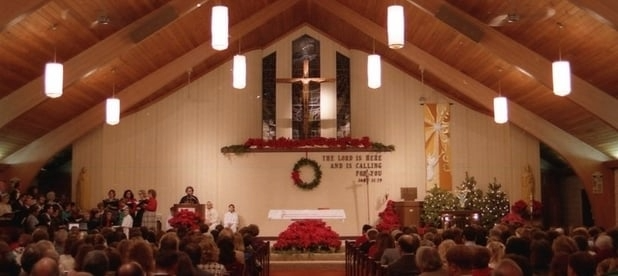
After much prayer, hard work, and fund-raising, construction of a new church to seat 800 began in early October, 1994. This had been a dream from the beginning, a new Church in the field on the corner lot of Clays Mill and Hill N’ Dale Roads. It, indeed, became our field of dreams!The stained glass window, crucifix over the Altar, as well as refurbished Stations of the Cross from the original place of worship were moved and installed into the new church to help foster the continuity of our parish community.
1995: As the work moved toward completion, the date of October 1, 1995, was set as the date of Dedication. Bishop J. Kendrick Williams, Diocese of Lexington, dedicated the new worship space on Sunday, October 1, 1995 at 3:00 p.m. As the day began, Sunday Mass was celebrated in the “old” church for the last time. There was sadness as some recalled the good times of spiritual growth, sacraments received, and relationship with God strengthened. An era ended and another began. Music was being played in the Rosary Garden and in the “old” church. Parishioners and guests were gathering. At 3:00 P.M. Bishop Williams joined this group and the Dedication began with a prayer of thanks for all His blessings. The Bishop, priests, and laity went in procession to the entrance of the new building. The Bishop was presented with a set of plans, our Parish mission statement and key to the Church. Fr. Bob opened the Church for all to enter. The people, the Altar, and the Church were sprinkled and the Liturgy of the Word followed. Before the Liturgy of the Eucharist, the Rite of Dedication took place. The Rite consisted of the Prayer of Dedication, the blessing of the Altar, and the lighting of the Church. After Communion the Blessed Sacrament was brought to the Tabernacle in the Eucharistic Chapel for the Rite of Inauguration of the Tabernacle. A meal followed on the Church grounds. Once the new church was completed, it became evident that the present school was not sufficient for the continuing needs of education for our youngsters. The school had been expanded as far as was practical. The decision was made that a totally new physical plant for the school was needed.
2003: On October 3, 2003 Bishop Ronald Gainer and parish representatives broke ground for building our new Education Life Center that would become more than just a school. It would be home for our young people and a center for continuing Christian education for all ages.
2005: During the summer of 2005, the new Education Life Center rose to completion on the ground behind the old church/school, which was demolished, except for the cafeteria and gymnasium. In August of 2005, students returned to school in the new Education Life Center and a much needed new parking lot was built on the site of our old school. It was dedicated on September 25 th . Enrollment continued to increase.
The new church and Education Life Center of Mary, Queen of the Holy Rosary stands as a testimonial to the faith of the men and women, boys and girls of the parish. This includes all who have gone before, those who will come, and especially those who presently are the Church of Mary, Queen of the Holy Rosary.
2006: In February, four additional classrooms were built. During this time, the previous By-Laws of the Parish Pastoral Council were studied and revised to ensure that all activities of the parish would be represented through the council. The existing Parish Mission Statement was also reviewed and only slightly modified. A small group of parishioners (after listening to a presentation by Sister Faustina), headed up by Dolly Van Daniker and Jim Cloud, presented a large painting, portraying "DIVINE MERCY" for display in the new church.
2007: With the anticipated arrival of an additional priest, other parish priests, and numerous visiting seminarians and guests, the Parish Pastoral Council determined that a new residence was needed for the priests. Several options were investigated and a house on Wellington Way was temporarily rented from a parishioner. It was then determined to purchase a home on Hill ‘N Dale, the other side of Clays Mill and renovate it to provide four bedrooms and adequate parking space.
2008: With the arrival of Fr. Eulices Godinez, a weekly Sunday Mass at 1:00pm began in Spanish. With that, our Hispanic community expanded to about 800 families. The new priest’s residence was completed and first occupied on December 20 th. Becky Brown was hired as Principal, Mary Queen School for the 2008-2009 school year.
2009:
The Liturgy Committee purchased and placed large vigil offering candles in front of the statutes of The Blessed Virgin Mary and St. Joseph on each of the inside walls of the church. These had been requested by some parishioners since the new church was built
2010: On August 1st , Rev. Dan Noll was appointed as pastor and installed by Bishop Ronald Gainer. He replaced Rev. Bob Nieberding, who for the prior year served as Parish Administrator. Fr. Dan previously served as pastor of St. Leo's in Versailles. About 2,000 families now call Mary, Queen of the Holy Rosary parish their spiritual home.
2010: The 50th Anniversary of the founding of our Parish was celebrated with a special Mass by Pastor Dan Noll, and festivities.
2011:
The Faith in Our Future campaign continued.
2014: 2000 families were registered in the Parish. The Mortgage on the new priest’s house was fully paid, with help from a generous private donation, in May 2014; and the mortgage was formally burned at an Open House for the entire Parish, in June. In September, a second Mass in Spanish was added at 9:30am on Sunday in addition to the 1pm Mass. Fr. Miguel Alvizures was assigned Parochial Vicar in July 2014.
2015: In November, a refugee family of 12 from the Congo came to Lexington in 2015 and were welcomed by Mary Queen Church. Many, being Catholic, they spoke Swahali, but were made to feel at home here. This group has now grown to over 20. Fr. Vitner Martinez, from Belgium, speaks Swahili and is working with them. He spent 5 years in Africa, before coming here for a visit.
2016: In March, the first parish ACTS Retreat was held separately for Men and Women, English and Spanish. This is planned to continue twice each year. Fr. Vitner Martinez was assigned Parochial Vicar on August 28, 2016.
At the Easter Vigil, 42 were Baptized. In May, 81 were Confirmed. At the Easter Vigil Mass we unveiled paintings of praying angels that now grace the walls of the alcoves on either side of the altar. These paintings were donated to Mary Queen by parishioners Jane and Richard Leake and Jane's siblings, Ann and Jerry Porter, Layne and Peggy Lohmar, Martha and Jack Gruber, and Ellen and John Moak in memory of Jane's parents, Fidelis and Edward Lohmar. The praying angels reflect the solid foundation of prayer, particularly the Rosary, that Jane received from her parents and the spirit of giving back to her church family that which her parents exemplified so well. Anne Little was the artist commissioned to paint the angels.
2017:
Personnel changes: Stacie Sutter resigned as Parish Life Coordinator and was replaced by Melissa Sloan.
2018: in July, long time Business manager, Walter Leachman retired. Brian Carlson took over as Business Manager. Brian Hunt returned as Music Director.
2019: in September, plans were announced to renovate the Sanctuary, Gathering Area, Eucharistic Chapel, Reconciliation, and Meeting Rooms in 2020. Zach Wiley was hired as Facilities Manager, a new position.
2020: In dealing with the COVID-19 pandemic increased efforts at communication and live streaming of Masses become necessary. Public Masses were suspended from March through May. Renovation of the church began in May and included new pews and flooring and many additional improvements including a new sound system and opened August 1st.
A simple celebration was held per COVID-19 protocols to commemorate the 25th Anniversary of the Dedication of the Church. Bishop John Stowe blessed the inside at one of the first nights we held confirmation.
Personnel changes: Angie Allen (Youth Group) and Kabby Akers (Young Adults & Justice Ministry) both retired. Tara Kaufmann was hired as Operation Manager (former title - Business Manager). James Harding took on several administrative roles.
2021:
Deacon John Becerra was hired as a Pastoral Associate in July. Rev. Ramiro Reyes was hired as a half-time Parochial Vicar in November. Personnel changes: Karen Estes retired as K-12 Religious Formation Coordinator 9/25; 10/1 Casey Phillips was hired. In November, Camilla Valencia resigned as Pre-School Coordinator and Stephanie Beeken was hired.
2022:
Fr. Dan Noll retired on 6/30/2022. Under his 12-year leadership, Mary Queen hosted 11 Women's CRHP (Christ Renews His Parish) retreats and 8 Men's CRHP retreats in English. He also implemented the ACTS (Adoration, Community, Theology, and Service) retreats at MQHR, resulting in 5 women's and 3 men's English retreats and 5 women's and 5 men's retreats as of April 2024.
In March, outdoor stations of the cross were installed (donation from CRHP 11 and parishioner James Cloud). In July, the parish offices were relocated from the stone building to the Educational Life Center. The stone building was designated as the youth and young adult building. Leslie McGraw was hired as business administrator. Fr Miguel Alvizures was installed as Pastor at the end of July. Jennifer Longworth was hired as parish life / communications coordinator. Beth O'Sullivan joined the staff as Youth / Young Adult Coordinator.
2023:
On May 28th (Pentecost), the parish introduced a new parish mission statement: "Receive God's Love, Proclaim the Greatness of the Lord, Serve Joyfully, and Make Missionary Disciples of Jesus Christ."
In the fall, we replaced our Sunday faith formation program with a Wednesday evening family faith formation night with dinner served for everyone.
2024:
Kimberli Castelan was hired as part-time bilingual secretary to help Jane Tucker and Christina Aguilera in the parish office. After comprehensive research and a feasibility study, the Together in Christ Capital Campaign was launched. The main goal of the campaign is to pay off the ELC Debt, followed by a secondary goal of building a new adoration chapel. Deacon Bill Rood retired after 16 years of service at MQHR. Fr. Michael Flanagan joined MQHR as parochial vicar in July 2024. Chris Claunch was hired as Youth / Confirmation Coordinator.
2025: Elvira Portillo was hired as full-time bilingual secretary. Leslie McGraw was promoted to Business Manager.
2026: Ordination of John Becerra. Hiring of Donovan Rodriguez as Youth/Young Adult/Confirmation Coordinator. Chris Claunch becomes Development Director.
Original Parishioners
Mrs. Judy Abell, Mr. Billy Allison, Mrs. Dorothy Allison, Mrs. Mary Augustyn, Mr. & Mrs. Hugh Beaven, Mr. & Mrs. Wayne Bell, Mr. & Mrs. David Berry, Mrs. Lorraine Bowen, Mrs. Delores DeMeo, Mr. & Mrs. John Feltman, Mr. William Flynn, Mr. & Mrs. John Haney, Mrs. Florence Hewett, Mrs. Loraine Huston, Mr. & Mrs. Robert Jobe, Mr. & Mrs. Charles Kragel, Mrs. Grace Lynch, Lucille Brick, Mrs. Ann Miller, Mr. James Mitchell, Mrs. Marie O'Rourke, Mr. & Mrs. E. W. Owens, Mr. Fred Shafer, Mrs. Phyllis Shannon, Mrs. Edith Southwood, Mrs. Anna Tharp, Mr. & Mrs. John Wathen, Mr. & Mrs. Ron Wedding, Catherine Willett, Mr & Mrs Loren Terhune
Clergy assigned to Mary, Queen of the Holy Rosary are:
1960-1980 – Leonard B. Nienaber, Pastor
1961-1962 – Rev. Jack McGuire, Associate Pastor
1962 – Rev. James McHugh, Associate Pastor
1962-1965 – Rev. Irwin Wolke, Associate Pastor
1964 – Rev. Ray Broering, Associate Pastor
1965-1967 – Rev. Roger Kriege, Associate Pastor
1967-1970 – Rev. William Bush, Associate Pastor
1970-1973 – Rev. Tom Lubbers, Associate Pastor
1973-1974 – Rev. John Cahill, Associate Pastor
1974-1978 – John B. Modica, Associate Pastor
1980-1987 – Rev. John Mueller, Pastor
1979-1983 – Rev. Gerry Reinersman, Associate Pastor
1983-1989 – Rev. Pat Stewart, Associate
1987/07-08/1987, Rev. William Brown, Pastor
1987- 2002, Rev. Robert Nieberding, Pastor
1989-1992 – Rev. Richard Edelen, Associate Pastor
1990-2001 – Jeremiah Noe, Deacon
1990-1991 – Dennis O'Neill, Deacon
1991-2000 – Rev. Lou Schmidt, in residence
1992-1994 – Rev. Richard Wilson, Associate Pastor
1994-1996 – Rev. John Moriarty. Associate Pastor
1996-1999 – Rev. Mark Dreves, Associate Pastor
1999-2022 – Jim Paris, Deacon
1999-2001 – Rev. Linh Nguyen, Associate Pastor
2001-2002 – Rev. Patrick Fitzsimons, Associate Pastor
2002-8/20 to 7/1/2006 – Rev. Dan Noll, Priest Moderator
2002-8/20 to 6/30/2006 – William Greenwell, Pastoral Director
2002-8/20 to 6/30/2005 – Rev. John Moriarty, Sacramental Minister
2003-7/2006 – William Greenwell, Deacon
2003-2006 Rev. Danny Schwendeman, Sacramental Minister
2004-2010 – James Horine, Deacon
2005-2006 --Rev. Jacob (Kurian) Oravanamthadthil, Sacramental Minister
2006-2010 – Rev. Joseph Muench, Pastor
2006-2007 – Rev. Stephen Roberts, Parochial Vicar
2007-2009 – Rev. Noel Zamora, Associate Pastor
2008-2011 – Rev. Eulices Godinez, Parochial Vicar
2008-2024 – Bill Rood, Deacon
2008-2021 – Bob Kotzbauer, Deacon
2009-2010 – Rev. Nicholas Pagano, Parochial Vicar
2009-2010 – Rev. Robert Nieberding, Administrator (pro tempore)
2010-2022 – Rev. Dan Noll, Pastor
2011-2013 – Rev. Jeffrey Estacio, Parochial Vicar
2012-2018 – Joe Daugherty, Deacon
2013- 2014 – Rev. Arockiadas Arokiasamy, Parochial Vicar
2014-2016 – Rev. Miguel Alvizures, Parochial Vicar
2016- – Nick Nickl, Deacon
2016-2019 – Rev. Vitner Martinez. Parochial Vicar
2018 to 10/2018 – John Coe, Deacon
2019-2021 -- Rev. Carlos Martinez, Parochial Vicar
2019- 2021 --Rev. Aldrin Tayag, Parochial Vicar
2021-2026 -- John Becerra, Deacon / Pastoral Associate
2021-2024 -- Rev. Ramiro Reyes, Parochial Vicar
2022 -- Rev. Miguel Alvizures,
Pastor
2022-2024 -- Rev. Ben Horn, Parochial Vicar
2024-2026 -- Rev. Michael Flanigan, Parochial Vicar
2026- -- Rev. John Becerra & Rev. Francisco Alfaro, Parochial Vicars
last updated 10/01/2026 jkl